Postline Foundation RepairPostline Foundation Repair

Foundation Settlement Monitoring Macon

Bibb County sits in the Fall Line Hills, the geological boundary where the Piedmont meets the Coastal Plain. Soils in this zone shift between red clay upland and sandy fill depending on which block you are on, a…
Get My Free Estimate →
Foundation Settlement Monitoring in Macon, GA
Quick answer
  • Included: baseline elevation survey, crack-width reference markers, written findings summary left with the homeowner after every visit, and a clear written statement on whether movement appears active or dormant.
  • Duration: a single monitoring visit takes 1, 2 hours on-site; a full monitoring program typically spans 3 to 12 months with visits every 4, 8 weeks depending on observed movement rate.
  • Cost: monitoring programs in Macon generally range from roughly $150, $350 per scheduled visit; exact pricing is confirmed after a free on-site assessment, never quoted sight-unseen.
  • What we assess: stair-step brick cracks, interior drywall cracks, door-frame racking, floor-slope readings, and any previously installed repair hardware to check for load transfer or continued movement.
  • How to schedule: call Postline Foundation Repair to arrange a free initial assessment; monitoring intervals are set based on what the baseline visit reveals.

Bibb County sits in the Fall Line Hills, the geological boundary where the Piedmont meets the Coastal Plain. Soils in this zone shift between red clay upland and sandy fill depending on which block you are on, a dynamic that directly affects how foundations move and how long active settlement continues after it starts. In neighborhoods like Vineville and Ingleside, where many homes were built between the 1920s and 1950s on shallow continuous footings, a single stair-step crack in a brick veneer can represent decades of slow, stable creep or the early sign of accelerating movement. The only way to tell the difference is measured data collected over time.

Monitoring is the right fit when a homeowner notices a crack or sloping floor but an initial inspection cannot confirm whether movement is ongoing. It is also the appropriate step after a completed pier or wall repair, to verify that the installed system has arrested settlement and that adjacent unrepaired sections are not beginning to load-transfer. In areas like Shirley Hills and Wesleyan Woods, where mature hardwood root systems run beneath older slab-on-grade and pier-and-beam homes, seasonal soil moisture changes, especially during Macon's dry summers and wet winters, can cause cyclical movement that looks alarming but is not structurally progressive. Monitoring separates those two scenarios with numbers rather than guesswork.

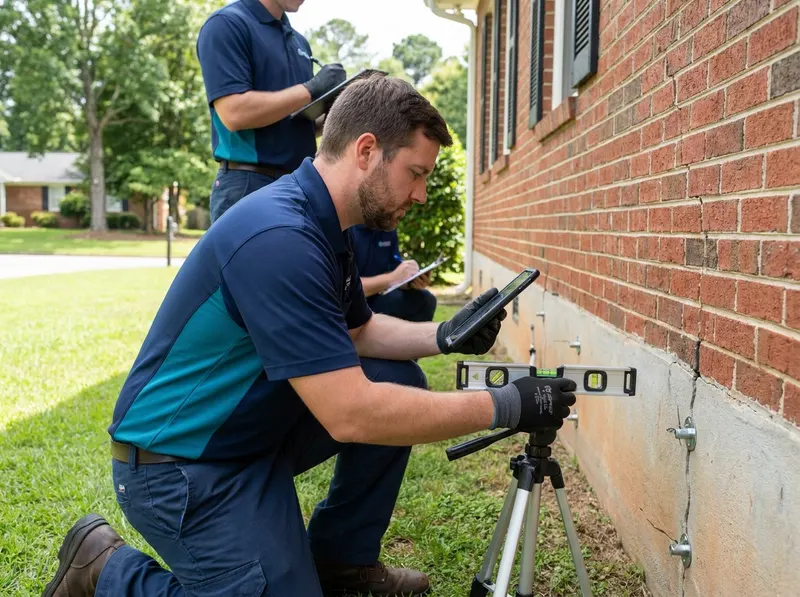
A monitoring program at Postline Foundation Repair works in three numbered steps. First, a baseline visit establishes reference points: elevation benchmarks at each corner and mid-span, crack-width markers placed directly on masonry or drywall, and floor-slope readings taken with a digital level. Second, follow-up visits at agreed intervals re-measure every reference point and record the delta, the exact millimeters of change since the last visit. Third, a written findings summary is prepared after each visit and left with the homeowner regardless of outcome; if the data shows no measurable movement across three consecutive visits, the written summary says exactly that. Homeowners in College Hill and Napier Heights preparing for a refinance or sale have used those summaries as documentation for lenders and buyers, because the report reflects observed measurements rather than opinion.

The critical distinction homeowners sometimes miss: monitoring is not the same as repair, and it is not a substitute for repair when active movement is confirmed. If successive visits show measurable downward drift, even 2, 3 millimeters per month sustained over two or three intervals, that data becomes the evidence base for sizing a pier installation or wall stabilization correctly, rather than estimating from a single snapshot. Homes near the heavier clay soils of Huguenin Heights or the older fill zones around Bloomfield sometimes show exactly this pattern: apparent stability at first look, then slow confirmed movement in the data. Catching that early, with documented measurements, keeps repair scope smaller and cost lower than waiting until movement becomes visible to the naked eye.

Foundation Settlement Monitoring cost in Macon

Free initial on-site assessment (baseline scoping)$0
Single monitoring visit (measurement + written summary)$150, $350
3-month program (baseline + 2 follow-up visits)$400, $900 ballpark
6-month program (baseline + 4, 5 follow-up visits)$750, $1,600 ballpark
Post-repair verification program (3 visits after pier/wall work)$350, $800 ballpark

Every job gets a firm, written price after a free on-site visit.

Common questions

How do I know if I need foundation settlement monitoring or an immediate repair in Macon?
Monitoring is appropriate in Macon when an inspection finds cracking or slope but cannot confirm whether movement is still active. If the initial assessment reveals a crack that has been stable for years with no recent change, monitoring may be the only action needed. If the inspection finds active structural displacement, a wall leaning measurably out of plumb, a footing visibly dropped, repair is typically recommended without waiting for a monitoring period.
How long does a foundation settlement monitoring program typically last in Macon, GA?
Most monitoring programs in Macon run 3 to 12 months. Three months covers one full seasonal moisture cycle in Bibb County and is usually enough to distinguish cyclical movement from progressive settlement. Homes on the clay-heavy soils common in areas like Vineville or Huguenin Heights sometimes warrant a full 12-month program to capture both the dry-summer contraction and the wet-winter expansion cycle before drawing conclusions.
What exactly is measured during a monitoring visit in Macon?
Each visit records elevation benchmarks at foundation corners and mid-span points, crack widths at every marked location using a calibrated gauge, and floor-slope readings at interior reference points. The delta, the change from the previous visit, is the operative number. A crack that measures 4 mm wide at baseline and 4 mm wide eight weeks later is not growing; one that measures 5.5 mm is, and that difference drives the next decision.
Can monitoring documentation help during a home sale or refinance in Macon?
Yes. Macon homeowners in neighborhoods like College Hill and Wesleyan Woods have used written monitoring summaries as supporting documentation when a lender or buyer's inspector flags a crack. A summary showing three consecutive visits with zero measurable change is objective evidence of stability. That documentation does not replace a licensed structural engineer's letter if one is specifically required, but it provides measured data that supports that evaluation.
Does foundation settlement monitoring in Macon cost the same as a repair?
No, monitoring costs significantly less than repair. A single monitoring visit in Macon typically runs $150, $350, and a full 6-month program generally falls in the $750, $1,600 range depending on visit frequency and site complexity. A pier installation or wall repair on a Macon home is a separate scope entirely and is priced after confirmed movement data justifies it. Monitoring is not a down payment on repair; it is a standalone diagnostic service with its own findings.
Helpful resources

Trusted references & local links

USA.gov, government & consumer helpBetter Business BureauFTC Consumer AdviceU.S. Small Business AdministrationReady.govU.S. EPAENERGY STARU.S. Dept. of EnergyConsumer.govU.S. Census BureauGoogle Maps, Macon, GA

Get started today

Tell us about your foundation settlement monitoring job in Macon and we'll send a clear, written quote, usually the same day.

Get your free Foundation Repair quote, Macon

We only use your ZIP to check availability, no spam.