Macon's soil is a core part of this story. Bibb County sits within the Ocmulgee River basin, where the underlying geology shifts between sandy fill near lower-lying areas and dense, moisture-reactive clay in…
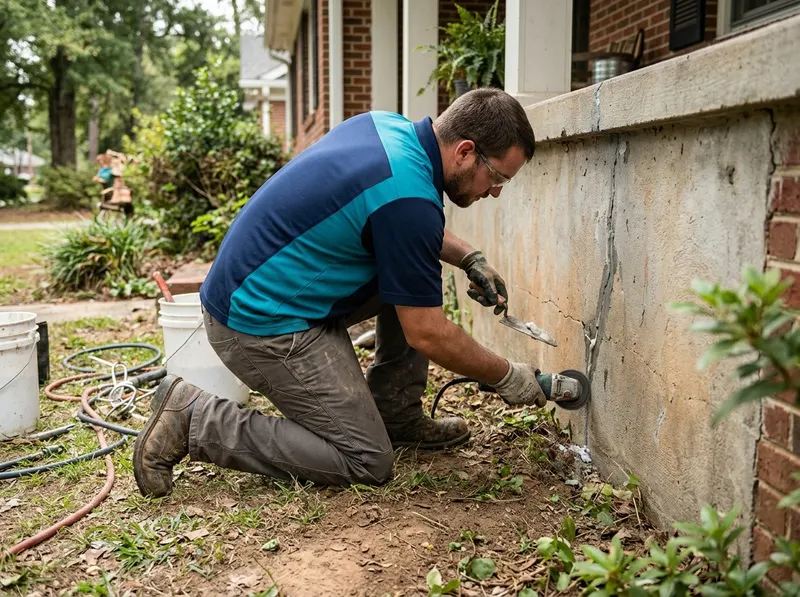
Macon's soil is a core part of this story. Bibb County sits within the Ocmulgee River basin, where the underlying geology shifts between sandy fill near lower-lying areas and dense, moisture-reactive clay in established neighborhoods like Ingleside, Vineville, and Shirley Hills. That clay expands when the summer rains come and contracts sharply during dry stretches, a seasonal cycle that exerts lateral and vertical pressure on foundation walls that were never designed to absorb it indefinitely. The stair-step crack running through a brick foundation in Beall's Hill and the horizontal crack widening in a block wall in Napier Heights are often the same root cause expressed in different materials.
Not every crack signals the same problem, and misreading the pattern leads to either unnecessary spending or a repair that addresses the symptom without touching the cause. Vertical cracks narrower than 1/16 inch are frequently shrinkage cracks from the original concrete cure, they rarely require structural intervention, though sealing them against Macon's humidity is still worth doing. Horizontal cracks in block or poured walls are a more serious indicator: horizontal cracking typically means lateral soil pressure is exceeding the wall's design capacity, a condition that tends to worsen if left unaddressed. Diagonal or stair-step cracks, common in the older brick foundations found throughout College Hill and Huguenin Heights, usually point to differential settlement, one section of the footing moving at a different rate than another. The repair method follows directly from the diagnosis: epoxy injection for structural re-bonding of a static crack, polyurethane foam for active water infiltration, carbon-fiber straps for walls that have deflected but have not yet exceeded the threshold where replacement becomes necessary, and helical wall anchors for walls that require both stabilization and potential future re-plumbing.
The decision between carbon-fiber reinforcement and wall anchors comes down to two measurable factors: the degree of inward deflection and whether the wall has room to be pulled back toward plumb over time. Carbon-fiber straps are bonded to the wall surface and prevent further movement, they are the right fit when deflection is under roughly 2 inches and the goal is to stop progression. Wall anchors extend through the foundation into the soil beyond the pressure zone and can be periodically tightened; they suit situations where some degree of re-plumbing is desired. In practice, many Macon homes in Wesleyan Woods and Bloomfield that were built in the 1950s and 1960s on shallow footings fall into a range where either method is defensible, the on-site measurement is what determines which fits the specific wall condition. Postline Foundation Repair leaves a written findings summary after every assessment so the homeowner has a documented baseline regardless of next steps, a record that also proves useful during a future refinance or sale in Bibb County's competitive resale market.
Every job gets a firm, written price after a free on-site visit.
Tell us about your foundation crack repair job in Macon and we'll send a clear, written quote, usually the same day.
 Postline Foundation Repair